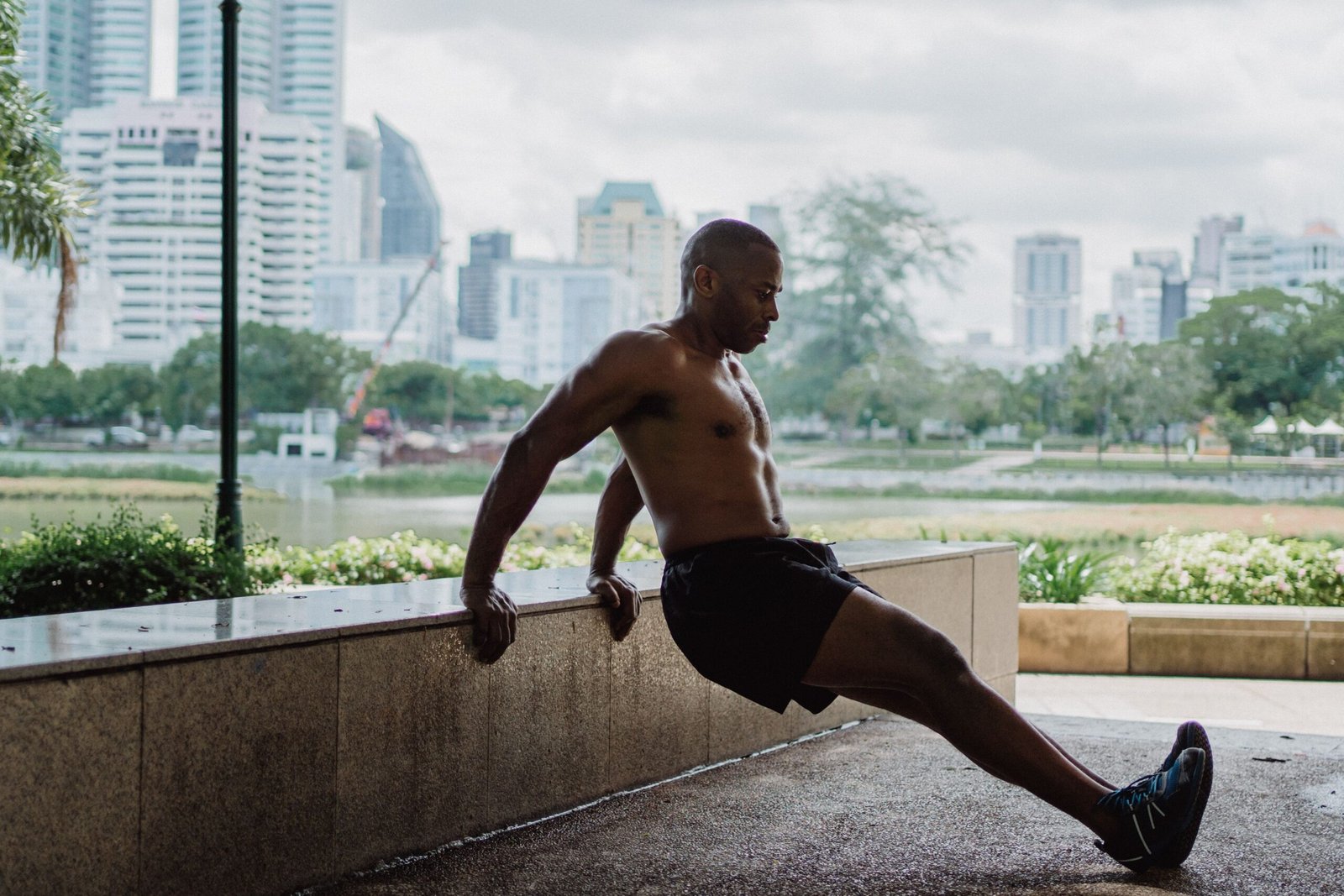
Bodyweight exercises those who can’t do ten honest push-ups call bodyweight activities “too easy.” In fact, your bodyweight is a fully customizable gym with resistance dials, hand positions, pace, leverage and single leg variations that exceed what most people would ever need.
Research by Harvard Health found that regular participants in bodyweight circuit training saw a 33% increase in aerobic capacity and an 11% increase in core muscular endurance. Here are ten bodyweight exercises that will work your whole body, and how to do them correctly as well as how to adjust their difficulty levels to your starting point.
Bodyweight training speaks the language of strength, a conversation between your muscles and your nervous system. Rather than pushing a padded machine along a set track , you are moving your entire body . This means that the smaller stabilizing muscles around your shoulders , hips and spine are also being exercised , as well as the larger movers . These movements work the stabilizers that weighted machines often miss, according to Harvard Health.
The other is the conformity factor. And this is why simple exercises at home, like wall press-ups and sit-to-stands, are considered by the NHS to be valid strength training. A 15-minute workout in your kitchen is one you will actually do.
Top 10 Bodyweight Workouts
1. Push-ups
The standard upper body workout is one repetition of the chest, shoulders, triceps and core. hands under shoulders, elbows at 45 degrees, torso rigid, chest to height of a fist off the floor easier hands on a wall or counter. On a chair with elevated feet it is harder.
2. Sit down
Stand with your feet shoulder-width apart. Sit back and forth, putting your weight in your heels. Track your knees over your toes. Align your thighs. Stand. Simpler: lean over a chair and give it a tap. A paused squat or a three second lowering is more challenging.
3. Reverse Lunge
Step back a foot, drop your back knee to the floor, and lift your body up and then push yourself back to standing. The reverse lunge is easier on the knees than the forward lunge, as the front foot stays on the ground. It’s easier to hold a door frame. Walking lunges across the room are harder.
4. Bridge (Glute)
Lie on your back, knees bent and drive through your heels creating a straight line from your shoulders to your knees. Squeeze at the top for 1 second. This is the cure for sitting all day. Limits the range of motion, makes it easier. Single-leg bridges are harder.
5. The Plank
Inhale. Keep your body in a straight line. Squeeze your glutes, and keep your forearms down. If your lower back pinches or your hips slouch, the set is over, no matter what time it is. It’s easier on your knees. It is harder to lift one foot an inch off the ground.
6. Row (Table or Doorframe)
Now, lean back, with your arms straight, your hands on the edge of a heavy table or a strong door frame, and pull your chest toward your hands. Rounded shoulders are caused by backless training programs. It is the only horizontal pulling option in the popular bodyweight exercises, and so cannot be compromised. It is easier to stand up straighter. Harder. Push your feet further under the table.
7. Dead Bug
Supine with arms overhead and knees bent at 90 degrees. Lower the opposite arm and leg toward the floor, but don’t lose connection in your lower back. It seems that until your core objects it does not matter. Easier: Keep your arms up and just move your legs. More difficult: decrease the descending phase to three seconds
8. The Bird-Dog
Extend the opposite arm and leg to full length from your hands and knees, hold for two seconds, and switch sides smoothly. One limb is easier to extend at a time To increase the difficulty, pause five seconds between each repetition.
9. Progress
Stand up steady with your whole foot on a firm chair or stair. Go down the same way. Of all the body-weight exercises, climbing stairs are among the most transferable. Easier lower stage. The backpack is more difficult to hold.
10. Perform a wall sit
Slide down the wall until your thighs are parallel to the floor and your back is flat against the wall, then hold. Efficient, static, not comfortable.
15-Minute Circuit Workout
Two complete cycles of six movements, 40 seconds of work, 20 seconds of rest. Take a minute to relax between rounds.
Squats.
Push ups (the most basic version)
Reverse Lunges
rows in table
Glute bridge
Plank
Total time around 15 minutes with a 3 minute arm circle and marching warm up. The CDC recommends a full strength program of two to three times per week that includes 150 minutes of moderate activity and two days of muscle-strengthening exercises each week.
HOW TO SCALE ANY BODY WEIGHT EXERCISE
Don’t switch to a different workout when an exercise becomes easy Instead, scale the previous one in this order:
Reps should be 8 to 15.
Slow down 3 seconds.
At the most difficult moment, add a full second pause.
A Word on Safety
Do a three minute warm up before circuits, because it’s the cold tendons that complain. Don’t change reps, leverage and tempo all in the same week. Progress one variable at a time. If you have heart disease, hypertension, or if you have a recent injury, get a doctor’s approval before starting any session if you experience sharp joint pain, numbness or dizziness.
FAQs
Can You Build Muscle With Bodyweight Exercises? Yes, to some degree. Beginners can build more muscle in six to twelve months. After that, the improvement continues with more load.
When do push-ups become second nature? Most beginners who train twice a week progress from counter to floor push-ups in four to six weeks.
Bodyweight Exercises without Cardio: Are They Enough? Yes, for strength. Walking is good for heart and lung health, the two together fulfilll all major recommendations.
Internal links are links to your Home Workout for Beginners article from the circuit section and Full Body Workout from the movement-patterns discussion.
1 thought on “Bodyweight Exercises The 10 Moves Worth Mastering”